|
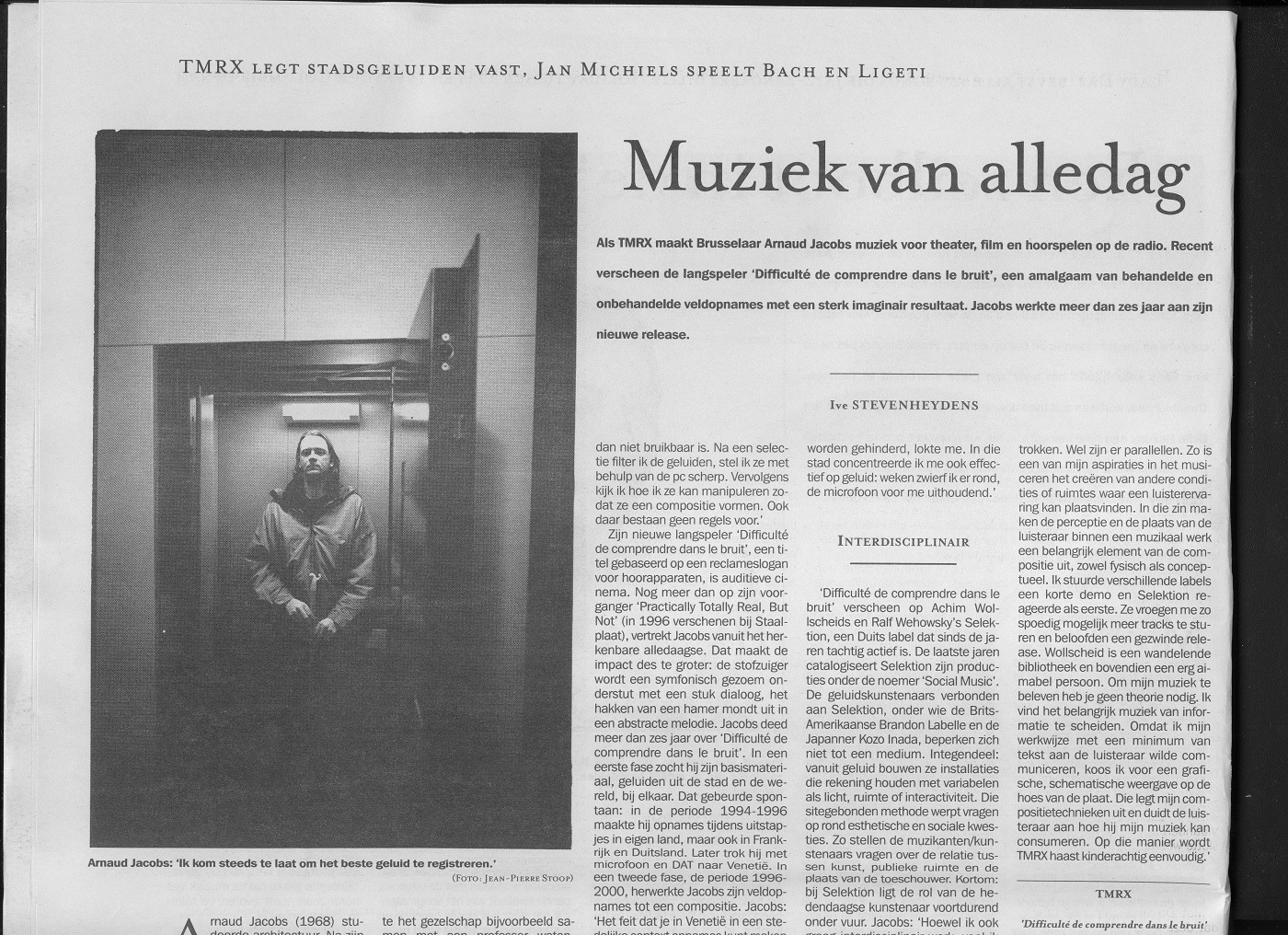
Press From: Tijd Cultuur 182 19 Dec 2001 By Ive Stevenheydens Symfonie van alledag Als TMRX maakt Brusselaar Aernoudt Jacobs muziek voor theater, film en gehoorspelen op de radio. Recentelijk verscheen de langspeler ‘Difficulté de comprendre dans le bruit’, een amalgaam van behandelde en onbehandelde veldopnames met een sterk imaginaire resultaat. Jacobs werkte meer dan zes jaar aan zijn nieuwe release: ‘Ik kom steeds te laat om het beste geluid te registreren.’ Aernoudt Jacobs studeerde architectuur. Na zijn studies aan het Sint-Lucasinstituut van Gent koos hij echter snel het muzikale pad. Vandaag komt hij in verschillende pseudoniemen: Mark Mancha (posttechno), Missfit (werk in opdracht voor ondermeer films) en TMRX, zijn belangrijkste en bekendste alter ego. Jacobs: ‘Tijdens mijn studie aan de academie knaagde het wantrouwen tegenover architectuur. In feite interesseerde me enkel de theorie, in de praktijk vind ik muziek interessanter. Parallellen tussen de disciplines zijn legio: in beide gevallen creëer je een bepaalde ruimte. In de eerste plaats heb je in muziek echter een grotere vrijheid. Zo zit je als architect met een overlegstructuur – van opdrachtgever tot gemeentebestuur – geplaagd. Het gevolg daarvan is dat je architecturale ideeën resulteren in halfslachtige bouwsels en frustraties. In de tweede plaats kan je als muzikant meer fysiek gaan: je kan zones afbakenen en – bijvoorbeeld met behulp van sinustonen – direct inspelen op de perceptie van de ontvanger.’ Jacobs collaboreert bij voorkeur met kunstenaars uit andere disciplines. Zo leverde hij in een recent verleden geluid voor kortfilms (van Gert Croux en Adem); verzorgde hij geluid bij een installatie (‘Avatar’, een project van Frank Theys voor de tentoonstelling ‘Mutilate?,’ in het kader van het Antwerpse evenement ‘Mode2001’) en steekt hij geregeld een hoorspel voor de radio in elkaar. Daarnaast maakt Jacobs deel uit van het jonge performancecollectief Fyke. Samen met regisseur/ theatermaker Kris Verdonck en videast/ dramaturg/ kunstenaar Alexis Destoop zoekt het drietal met spaarzame middelen naar een experimentele theatertaal. Daarbij ligt de nadruk eveneens op synergie, zij het nog ruimer: Fyke stoeit ook met velden die strikt genomen buiten de kunsten vallen. Deze maand werkte het gezelschap bijvoorbeeld samen met een professor wetenschapsfilosofie (de voorstelling met de hilarische titel ‘Eindige modellen van transfinite theorieën door paraconsistente quotiënt-structuren‘, een productie van het Brusselse kunstencentrum Nadine). Jacobs: ‘Als muzikant vind ik het belangrijk met verschillende uitgangspunten te spelen. Zulks biedt me een kader en vormt tegelijkertijd een uitdaging. Het medium theater vind ik daarbij bijzonder interessant: daar wordt mijn muziek een functioneel element. Dat omsluit vrijheid. Om klassieke eigenheden als ritme en melodie hoef ik me in zo een geval niet meer te bekommeren.’ Imaginair Als TMRX vertrekt Jacobs vanuit een fascinatie voor het geluid, in welke vorm dan ook. Vandaar dat de kunstenaar zijn basismateriaal uit de realiteit plukt: met microfoon en DAT-recorder maakt hij veldopnames. Met die fragmenten componeert Jacobs thuis, in alle rust op de computer. Het geluid van TMRX zweeft tussen het reële en het absurde. Zo vertrekt Jacobs van een herkenbaar geluid en bewerkt hij de klanken tot ze bevreemdend effect ressorteren, om bijvoorbeeld vervolgens opnieuw te onderscheiden geluiden toe te voegen. Samen vormt dat een imaginaire symfonie die uit geluiden van alledag is opgebouwd. Jacobs: ‘Ik heb mijn opnamemateriaal steeds bij me. Toch ben ik min of meer altijd te laat. Eer je DAT en microfoon boven hebt gehaald, is logischerwijs de interessantste actie al gepasseerd. Na opname selecteer ik het geluid. Dat berust op intuïtie en ervaring: ik hoef daar niet meer over na te denken. Bovendien weet ik meestal tijdens de opnames al of het geluid al dan niet bruikbaar is. Na een selectie filter ik de geluiden, stel ik ze met behulp van de PC scherp. Vervolgens kijk ik hoe ik ze kan manipuleren zodat ze een compositie vormen. Ook daar bestaan geen regels voor.’ TMRX nieuwe langspeler 'Difficulté de comprendre dans le bruit’ – een titel gebaseerd op een reclameslogan voor hoorapparaten – staat gelijk aan auditieve cinema. Nog meer dan op zijn voorganger ‘Practically Totally Real, But Not’ (in 1994 verschenen bij Staalplaat), vertrekt Jacobs vanuit het herkenbare alledaagse. Die zet maakt de impact des te groot: de stofzuiger wordt een symfonisch gezoem onderstut met een dialoog, het hakken van een hamer mondt uit in een abstracte melodie. Opgeteld deed Jacobs meer dan zes jaar over 'Difficulté de comprendre dans le bruit’. In een eerste fase zocht hij zijn basismateriaal, geluiden uit de stad en de wereld, bij elkaar. Dat gebeurde spontaan: in de periode 1994-1996 maakte hij opnames, tijdens uitstapjes in eigen land, maar ook in Frankrijk en Duitsland. Later trok hij met microfoon en DAT bewust naar Venetië. In een tweede fase, de periode 1996-2000, herwerkte Jacobs zijn veldopnames tot een compositie. Jacobs: ‘Het feit dat je in Venetië in een stedelijke context opnames kan maken zonder door het geluid van auto’s gehinderd te worden, lokte me. In die stad concentreerde ik me ook effectief op geluid: weken zwierf ik er rond, de microfoon voor me uithoudend.’ Interdisciplinair 'Difficulté de comprendre dans le bruit' verscheen op Achim Wollscheids label Selektion, een Duits huis dat sinds de jaren tachtig actief is. De laatste jaren catalogeert Selektion zijn betrachtingen onder de noemer ‘Social Music’. De geluidskunstenaars verbonden aan Selektion – onder wie de Brits-Amerikaanse Brandon Labelle en de Japanner Kozo Inada – beperken zich eveneens niet tot een medium. Integendeel: vanuit geluid bouwen ze installaties die rekening houden met variabelen als licht, ruimte of interactiviteit. Die site-gebonden methode werpt vragen op die zich grofweg rond esthetische en sociale kwesties centeren. Zo stellen de aangesloten muzikanten/ kunstenaars zich vragen over de relatie tussen kunst, publieke ruimte en de plaats van de toeschouwer in dat geheel. Kortom: bij Selektion ligt de rol van de hedendaagse kunstenaar voortdurend onder vuur. Jacobs: ‘Hoewel ik ook graag interdisciplinair werk, voel ik me niet heus tot hun theorieën aangetrokken. In feite stuurde ik verschillende labels een korte demo en Selektion reageerde als eerste. Erg enthousiast bovendien: ze vroegen me zo spoedig mogelijk meer tracks te sturen en beloofden een gezwinde release. Wollscheid staat voor een wandelende bibliotheek en is bovendien een erg aimabel persoon. Voor mijn muziek te beleven heb je geen theorie nodig, al kan een richtinggevend element de luisteraar helpen. Daarbij vind ik het belangrijk muziek van informatie te scheiden. Omdat ik een begeleidende tekst vaak belerend, pseudo-intellectualistisch of oninteressant vind, koos ik voor een schematische weergave die mijn compositietechnieken uitlegt en de luisteraar aanduidt hoe hij/ zij mijn muziek kan consumeren. Op die manier wordt TMRX haast kinderachtig eenvoudig.’
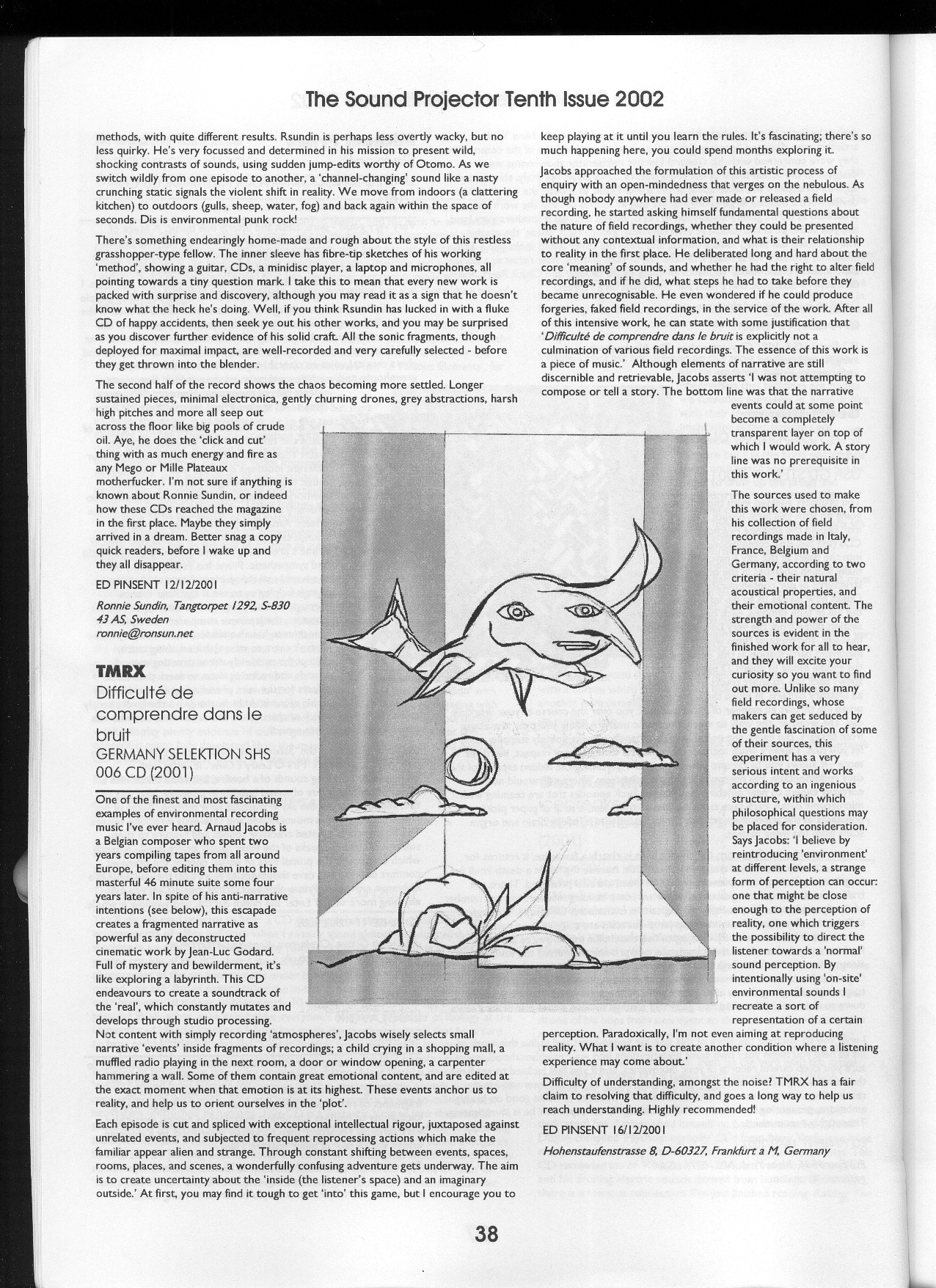
from : The Soundprojector 10th Issue 2002 By Ed Pinsent 2002 One of the finest and most fascinating examples of environmental recording music I've ever heard. Aernoudt Jacobs is a Belgian composer who spent two years compiling tapes from all around Europe, before editing them into this masterful 46 minute suite some four years later. In spite of his anti-narrative intentions (see below), this escapade creates a fragmented narrative as powerful as any deconstructed cinematic work by Jean-Luc Godard. Full of mystery and bewilderment, it's like exploring a labyrinth. This CD endeavours to create a soundtrack of the 'real', which constantly mutates and develops through studio processing. Not content with simply recording 'atmospheres', Jacobs wisely selects small narrative 'events' inside fragments of recordings; a child crying in a shopping mall, a muffled radio playing in the next room, a door or window opening, a carpenter hammering a wall. Some of them contain great emotional content, and are edited at the exact moment when that emotion is at its highest. These events anchor us to reality, and help us to orient ourselves in the 'plot'. Each episode is cut and spliced with exceptional intellectual rigour, juxtaposed against unrelated events, and subjected to frequent reprocessing actions which make the familiar appear alien and strange. Through constant shifting between events, spaces, rooms, places, and scenes, a wonderfully confusing adventure gets underway. The aim is to create uncertainty about the 'inside (the listener's space) and an imaginary outside.' At first, you may find it tough to get 'into' this game, but I encourage you to keep playing at it until you learn the rules. It's fascinating; there's so much happening here, you could spend months exploring it Jacobs approached the formulation of this artistic process of enquiry with an openmindedness that verges on the nebulous. As though nobody anywhere had ever made or released a field recording, he started asking himself fundamental questions about the nature of field recordings, whether they could be presented without any contextual information, and what is their relationship to reality in the first place. He deliberated long and hard about the core 'meaning' of sounds, and whether he had the right to alter field recordings, and if he did, what steps he had to take before they became unrecognisable. He even wondered if he could produce forgeries, faked field recordings, in the service of the work. After all of this intensive work, he can state with some justification that 'Difculte de comprendre dans le bruit is explicitly not a culmination of various field recordings. The essence of this work is a piece of music.' Although elements of narrative are still discernible and retrievable, Jacobs asserts 'I was not attempting to compose or tell a story. The bottom line was that the narrative events could at some point become a completely transparent layer on top ofwhich I would work. A story line was no prerequisite in this work.' The sources used to make this work were chosen, from his his collection of field recordings made in Italy, France, Belgium and Germany, according to two criteria - their natural acoustical properties, and their emotional content. The strength and power of the sources is evident in the finished work for all to hear, and they will excite your curiosity so you want to find out more. Unlike so many field recordings, whose makers can get seduced by the gentle fascination of some of their sources, this experiment has a very serious intent and works according to an ingenious structure, within which philosophical questions may be placed for consideration. Says Jacobs: 'I believe by I reintroducing 'environment' at different levels, a strange form of perception can occur one that might be close enough to the perception of reality, one which triggers the possibility to direct the listener towards a 'normal' sound perception. By intentionally using 'on-site' environmental sounds I recreate a sort of representation of a certain perception. Paradoxically, I'm not even aiming at reproducing reality. What I want is to create another condition where a listening experience may come about. Difficulty of understanding, amongst the noise? TMRX has a fair claim to resolving that difficulty, and goes a long way to help us reach understanding. Highly recommended! ED PINSENT 2002 By Massimo Ricci It's not easy getting good results with a record consisting exclusively of field recordings, but Aernoudt Jacobs from Belgium created a highly effective canvas of sounds which start as untreated, then they are processed in studio with additional concrete material on top; finally, they must be fully appreciated by the listener in his own environment. You'll feel really good when voices and everyday noises come to your ears in different combinations than usual, soft instead of hard, sudden rather than expected...and above all, surprisingly influencing your humor and thoughts. By Julien Jaffré Arnaud Jacobs décompose les sensations qui l'environnent depuis maintenant quelques années. Son parcours singulier et son perfectionnisme n'ont pasfavorisé la production de cet album, fruit d'un travail conséquent, regroupement d'idées disparates étalées sur quatre années nous permet de partager un peu de l'onirisme de son univers l'espace de 48 minutes. Deux ans d'enregistrement aux divers coins de l'Europe (Italie, France, Belgique, Allemagne). Un album qu'on peut qualifier de parcours initiatique, dont le but avoué est de mêler et de combiner bandes sons concrètes et manipulations électroacoustiques, dans un échange mutuel, une transformation raisonnée de chacune ; une bande son originale des paysages fréquentés et parcourus, puis réinterprété ici par l'auditeur à la manière picturale des impressionnistes. Un bon album et un excellent compositeur qui n'a pas à rougir de la promiscuité et le talent des autres artistes présents sur Selektion, de Toshiya Tsunoda à Brandon Labelle, Frans de Waard, Achin Wollsheid, Bernhard Gunter, Rlw Runzelstirn ou encore Lionel Marchetti. Pour ma part, on passe avec beaucoup d'aisance de moments d'accalmie (les plaines et plateaux) à des incursions furtives en territoire bouleversé (on pense par moment, dans le happement des séquences à du David Lynch période Lost highway ). Un album exigeant et varié qui donne une carte mentale pertinente de son auteur et une définition très personnelle du bruit. À écouter dans le noir. By Richard di Santo In approaching his new project, Arnaud Jacobs, aka TMRX, asked himself some of the fundamental questions around sound perception, representation and composition (can reality be acoustically reproduced? how can a field recording become a musical object? etc.). Although Jacobs is quick to point out that Difficulté de comprendre dans le bruit is "explicitly not a culmination of various field recordings," these recordings - capturing the sort of sounds you hear and are surrounded by every day - are nonetheless at the core of this work. When listening, the sounds open up before you; field recordings and concrete sounds appear in pure form only to be transformed by various treatments, in turns subtle and dramatic. You recognize a child's voice, fragments of words, of music, a growing wind, a passing car, the banging of objects, only to witness significant transformations before your ears. The treated sounds, droning, percolating and otherwise indescribable, surprised me at every turn. Subtle tones and fine textures carefully weave a fragile web around the sounds in the foreground. The production work on this CD is wonderful; the sounds appear with great clarity, occupying a wide frequency range and expanding into your own listening environment. Interestingly, the listener's room is identified in the insert as an essential part of the work; it is the fourth element, after three layers of field recordings (both untreated and treated) and concrete sounds. This is also the first time I have encountered a track 0 on a CD. By pressing the search back button from track 1, you can listen to about a minute's worth of sounds which act as a volume test for the rest of the CD. Because the volume fluctuates dramatically throughout these pieces, Jacobs was kind enough to give us a relative guide for setting up the optimum playback volume. Captivating, imaginative and complex, Difficulté de comprendre dans le bruit is an excellent new work that comes highly recommended. http://www.incursion.org/ Jeremy Keens A wide selection from this reinvigorated label it had gone quite quiet for a while but seems to be having something of a renaissance there was also the Inada disk in 2001. Nice packaging folding out card sleeve (like the ones Ritornell have stopped using), with the option of a liner essay attached to the inside. The design work by Charly Steiger, who has possibly done all Selektions work (RLW's 'Tulpas' for example; he is on the website as part of the team) is excellent, giving each disk an individual look, but maintaining a constant aesthetic. TMRX (Arnaud Jacobs) and Labelle work in similar territory combining samples and treatments, expecting interacting with the listening environment. TMRX includes diagrams of the four layers: field recordings; treated field recordings; additional recordings and concrete sounds; and finally the listeners environment. While Labelle talks (in an extended essay) of 'where public space starts and private impulse ends' and the 'interference' between various spaces. There approaches themselves cross and interfere. TMRX admits that there will be variable volume across this disk of manipulated samples; to help you set the correct volume, when you wind back from the start of track one you get a reference track a tone and a person talking, and you adjust the sound so that it seems like they are in the room with you. The first track 'Hoover' exemplifies the basic method it opens with a sound rather like a hoover moving around, using the soundspace, with noises behind; then the central section is tones, backwards noises, echoey, high ringing emerging, popping; then the machine returns for the final part. This shifting, particularly from sample to treatment and back, recurs. 'Unit' pulses and rings, with voices deep within and processed, then shifts into a ringing resonance like an underground station with stepping and tones, then throbs followed by voices and a baby in the underground. A collage of sounds provides a fragmented opening to 'Popcorn', and the body is similarly drifting through pulsing orchestra, talking, piano, match strikes, rattling, doors and loops shifting and overlapping. Loud hammering or squeaking rising and falling opens 'Klaag', joined by different squeaks, walking and talking, strange singing and then a rumble fade. 'Lagune' is a longer track which shifts through multiple parts: planes flying over creating interfering tones, guitar like sounds within; high tones and growls, bubbles of sounds, water; running on, tones and woobles; noisey drones rebuild the plane (a cropduster?); sireney notes, the plane indistinct; into a quiet long fade. In 'Ligne' talking and crackles and natural sounds run through the opening, lightly processed which shift into buzzing then a train, to slapping and a sine wave pulsing and changing, slap slow rumble and talking returns. A very different mood to 'Falls' which is quiet, a susurrus with light rumbles, whooshes, clicks and tones, slipping into 'Neighbour' which rumbles and tones, distant recorded music playing and a hollow tap to conclude. A fascinating melding of treated and untreated sounds that interact mysteriously with your own sound environment.
From Jade chroniques By Julien Jaffré L'histoire ne dit pas si l'on doit interpréter le titre comme un hommage au plus lounge des compositeurs Français 60'…. Ce 10' se découvre avec une pièce lente, bâtie comme un morceau de Gorecki, par répétition lente et fluctuante, par addition succincte de sons, qui, graduellement, pesamment, imprime tension et puissance, jusqu'à la libération totale, où la boîte à rythme déchire l'opacité grondante, la texture lourde du morceau. L'utilisation de cloches d'église en introduction de Face B n'est pas sans souligner l'aspect liturgique qu'ils souhaitent imprimer aux morceaux. On a bien du mal à reconnaître le Kubin de A_musik (Klankrieg, Felix Knoth à l'état civil) qui nous faisait onduler du bassin, moulé dans des chemises marron cintrées. Il est accompagné ici de Guenter Reznicek (Nova Huta, Hammond pop) et de Mark Mancha (amoud Jacobs) Une série de 3 10' (dont celui ci est le premier) verront se succéder Nocturnal Emissions avec "imaginary 99" puis Delphiums "self Vs self". Des morceaux qui recommandent une écoute prolongée pour vraiment s'en imprégner pleinement. Veuillez consulter la notice avant toute utilisation.
From Remote Induction Ipsomat Legrand is part of The Disaster Area trilogy of 10"s, the other two being those by Delphium and Nocturnal Emission. Ipsomat Legrand is unlike the other two in that it is a collaborative and remix release. The first side is the track Ipsomat Legrand and is a result of Kubin ( felix knoth aka felix kubin aka klangkrieg) and Rezniceck (Guenter Rexniceck of Gruenland Orchester) taking everyday sounds and building a piece of music. on the other side Mancha (Arnoud Jacobs aka Mark Mancha aka TMRX) takes the material that Rzniceck/Kubin have called Ipsomat Legrand and provides two remixes. With a hiss and tick we flow into Ipsomat Legrand, a mild crackling building between bass pulses. Hints of other elements flirt with the constant, some of which become part of the whole - like the building wire vibration. Sound expands with a kinetic energy, filled with motions combining. After a couple of minutes there is a voice, electronically muffled with the other sounds slowing and focussing behind that. The wire twang is core with a solid seesaw flick. A bip-bop pulse continues, early elements persisting through the introduction of new themes - plinking melodies and harder bass moments, all working to keep the constant dynamic. the first of Mancha's pieces is the Ensemble Mix, taking the tick and making it a tighter buzz. Into this comes the chatter of birds and a great clanging bell tower. A vibration sets up like a heart beat, and blips sound like imitation of the birds. Clipped beats add percussion and there are little sweeps. A minimal element works in the pulse of a bass come from the heart beat, little twitches and chimes working on that minimalist vibe. This builds then loses momentum, stripping down once more. On the whole this is a more subdued piece, working as a subtle extraction from the original with a more pronounced swirl. Continuing the piece loses focus wandering into the abstractions of the source while fading out to the repeat of the church bell. From the conclusion of the Ensemble in the same it started comes the Elastic Mix. This emphasizes bass and makes the ticks into a crackle. There is a background chatter, followed by a snatch of clear conversation and a moment of distinct melody. A resilient electronic pulse comes up, a stroking repetition. Layers come up - cuckoo sound, buzzing echo to the pulse, and a ticking pulse. In some ways this is the opposite of Ensemble - going for an emphasis rather than minimal, while at the same time having a suggestion of being casual coming from it.
TMRX is still a largely ignored name, despite his excellent CD on Staalplaat, years and years ago, and a handful of concerts in which the computer plays an important role (no laptop when I saw it. His CD has zero track (which can be reached by hitting the rewind putton), so you can set the volume for the entire CD; maybe an idea for others, Francisco Lopez for instance? TMRX, the work of Belgiums Arnaud Jacobs, deals here with environmental sounds. Sounds you hear everyday, recorded with windows open. So in 'Hoover' you hear the sound of a vacuum cleaner and a car passing. Gradually the hoover sounds are being transformed, and added are other external sound sources and sound effects. So, occassionally you recognize people talking, cars passing or a construction site, which all move in and out, and electronics do the rest. This work will appeal to the fans of MNortham, Roel Meelkop or Toy Bizarre (and of course it appeals to me as a strong work) (FdW) From Jade Arnaud Jacobs décompose les sensations qui l'environnent depuis maintenant quelques années. Son parcours singulier et son perfectionnisme n'ont pasfavorisé la production de cet album, fruit d'un travail conséquent, regroupement d'idées disparates étalées sur quatre années nous permet de partager un peu de l'onirisme de son univers l'espace de 48 minutes. From Incursion Music Review Selektion | SHS 006 | CD In approaching his new project, Arnaud Jacobs, aka TMRX, asked himself some of the fundamental questions around sound perception, representation and composition (can reality be acoustically reproduced? how can a field recording become a musical object? etc.). Although Jacobs is quick to point out that Difficulté de comprendre dans le bruit is "explicitly not a culmination of various field recordings," these recordings - capturing the sort of sounds you hear and are surrounded by every day - are nonetheless at the core of this work. When listening, the sounds open up before you; field recordings and concrete sounds appear in pure form only to be transformed by various treatments, in turns subtle and dramatic. You recognize a child's voice, fragments of words, of music, a growing wind, a passing car, the banging of objects, only to witness significant transformations before your ears. The treated sounds, droning, percolating and otherwise indescribable, surprised me at every turn. Subtle tones and fine textures carefully weave a fragile web around the sounds in the foreground. The production work on this CD is wonderful; the sounds appear with great clarity, occupying a wide frequency range and expanding into your own listening environment. From Ampersand Etcetera - 2001_20 TMRX (Arnaud Jacobs) and Labelle work in similar territory combining samples and treatments, expecting interacting with the listening environment. TMRX includes diagrams of the four layers: field recordings; treated field recordings; additional recordings and concrete sounds; and finally the listeners environment. While Labelle talks (in an extended essay) of 'where public space starts and private impulse ends' and the 'interference' between various spaces. There approaches themselves cross and interfere. TMRX admits that there will be variable volume across this disk of manipulated samples; to help you set the correct volume, when you wind back from the start of track one you get a reference track a tone and a person talking, and you adjust the sound so that it seems like they are in the room with you. The first track 'Hoover' exemplifies the basic method it opens with a sound rather like a hoover moving around, using the soundspace, with noises behind; then the central section is tones, backwards noises, echoey, high ringing emerging, popping; then the machine returns for the final part. This shifting, particularly from sample to treatment and back, recurs. 'Unit' pulses and rings, with voices deep within and processed, then shifts into a ringing resonance like an underground station with stepping and tones, then throbs followed by voices and a baby in the underground. from REVIEWS - by Touching Extremes A differenza dei nomi sinora contemplati, il terzetto che conclude questo gruppo di uscite ha trascorsi discografici meno noti, quindi diciamo che Felix Knoth (o Felix Kubin o Klangkrieg che dir si voglia) e Guenter Reznicek (ex Groenland Orchester) sono di provenienza tedesca, mentre Arnoud Jacobs (aka TMRX aka Mark Mancha aka Aernoudt Jacobs) ha radici belghe. I primi due occupano il lato A del 10” con il brano (che dà il titolo al lavoro) realizzatoin coppia e dove esplorano le potenzialità delle macchine ritmiche computerizzate abbinandole ad avvolgenti scenari da sbarco lunare, mentre Mancha propone un paio di remix dello stesso pezzo, spingendosi ai margini di un sound rilassato, acquatico, sintetico ed emotivo. Come avrete compreso il valore qualitativo delle tre uscite è elevato; proprio in virtù di ciò, consentitemi un’annotazione finale: possibile che la Disaster Area sia distribuita in Francia, Germania, Belgio, Stati Uniti, Spagna, Finlandia, Regno Unito, Olanda, Canada, ecc. e non ci sia un distributore discografico italiano che sia uno disposto a far circolare il materiale nel nostro Paese? Comunque sia, per qualunque contatto e/o acquisto, potete affidarvi al seguente indirizzo di posta elettronica: disaster_area@t-online.de. Abstraktion & Wärme Reznicek-Kubin-Mancha: Ipsomat Légrand (10'', Disaster Area 2001, DA013) Vertrieb: Hausmusik, A-Musik, Drone, Artware, Grand Harbour) Die A-Seite von Reznicek-Kubin beginnt mit dem Aufbau eines Koordinatensystems: elektronische Klangtupfer, mit großen Abständen im Raum verteilt à la Stockhausen-Kammermusik. Daraus formt sich nach und nach ein clubkompatibler, gerader Beat, um sich dann langsam wieder im unbestimmten Feld der Geräusche, aus dem er auftaucht, zu verlaufen - und das alles im Laufe einer knappen Viertelstunde: Aufstieg und Fall des Doktor Rhythmus, ein akustischer Entwicklungsroman. Die parallel zur A-Seite entstandenen Remixes von Mark Mancha gehen ziemlich verspielt an das nüchtern wirkende Breitwandformat Ipsomat Légrand heran. Ensemble Mix scheut sich nicht, einen gesampleten Kirchenglockensound zu verbraten, der irgendwie an billige Horrorhörspiele der 70er gemahnt - die Spannung zwischen solchen vordergründig 'realistischen' Klängen und der insgesamt doch abstrakten Textur des Stücks verleiht dem Track einen eigenartigen Reiz. Elastic Mix besticht durch Bass-Sounds von geradezu analog klingender Wärme, die sich zu verhalten groovenden Linien zusammenfinden - als würde man alte Motown- Soul-Platten durch eine Dschungelgeräuschkulisse hindurch hören. |